Caribbean Thoroughbred Aftercare- An Aftercare Ally
Continuing our series of interviews with other aftercare organizations, we gladly share our latest interview with Caribbean Thoroughbred Aftercare.
Where is Caribbean Thoroughbred Aftercare based?
Caribbean Thoroughbred Aftercare (CTA) is based on a 15-acre farm in Río Grande, Puerto Rico. We’re the only Thoroughbred Aftercare Alliance (TAA)-accredited equine rescue, rehabilitation, retraining, and sanctuary organization in the Caribbean. We’re also verified by the Global Federation of Animal Sanctuaries (GFAS) and a partner with the ASPCA Right Horse Initiative
How did your program begin?
CTA was founded in 2016. It began with Immortal Wink, a ten-year-old Thoroughbred gelding with 142 career starts who was still racing in Puerto Rico. Shelley Blodgett a racing fan grew concerned about him and reached out to Kelley Stobie to help get him retired. Together alongside his breeder ,Kathy Von Gerhard, they raised the funds to retire him and placed him with the Thoroughbred Retirement Foundation in Florida. That rescue showed them just how badly organized aftercare was needed in Puerto Rico and the wider Caribbean. Shelley and Kelley formalized that work into Caribbean Thoroughbred Aftercare. Ten years later, CTA cares for about 30 horses at a time as a full-service rescue, rehabilitation, retraining, sanctuary and educational program.
What makes CTA unique?
CTA has gone through some of the most rigorous accreditation standards in equine welfare. We offer the full continuum of care under one roof: veterinary rehabilitation, retraining, rehoming and adoption, and lifetime sanctuary for horses who can’t be safely placed. We also put our horses’ second careers to work for the community through programs like our Equine Academy, riding lesson program and “Paso a Paso”, an Equine Assisted Learning program we run inside a Puerto Rico correctional institution, a first for the Caribbean.
What happens when a horse is accepted into your program?
Every horse that comes to CTA begins with an intake veterinary exam followed by an individualized care plan. Some horses need only rest and groundwork before they’re ready for retraining and adoption. Others require months of rehabilitation for injuries or conditions, and some become lifetime sanctuary residents when they can’t be safely rehomed.
Do you work with other locations or farms in your program?
Yes. CTA works with several sister organizations on the mainland, including Second Stride, Rising Star, Serenity Oaks, and TRF. We also started the Virgin Islands Aftercare Fund, a partnership with Triple H Ranch that addresses the aftercare gap in the U.S. Virgin Islands. And we’re currently looking for funding to build a dedicated 50-acre CTA Equine Sanctuary here in Puerto Rico for horses that are piroplasmosis-positive or otherwise unadoptable, where CTA would retain ownership and full care responsibility for every horse placed there.
How many horses have gone through your program?
CTA currently cares for approximately 30 rescued Thoroughbreds at any given time. We’ve been doing this work since founding it in 2016. CTA has taken in over 348 horses and rehomed 252.
How does CTA receive funding?
CTA is a registered 501(c)(3) nonprofit funded entirely through fundraising, grants, and private donors. We receive very little government funding. Support comes from our accreditation partnerships like the TAA and the ASPCA Right Horse Program, Puerto Rico’s unclaimed tickets fund, individual donors, Legislative donations, campaigns like our annual Giving Tuesday stall-building drive, and grant funding.
Do you have a story about a horse that we can share with our readers?
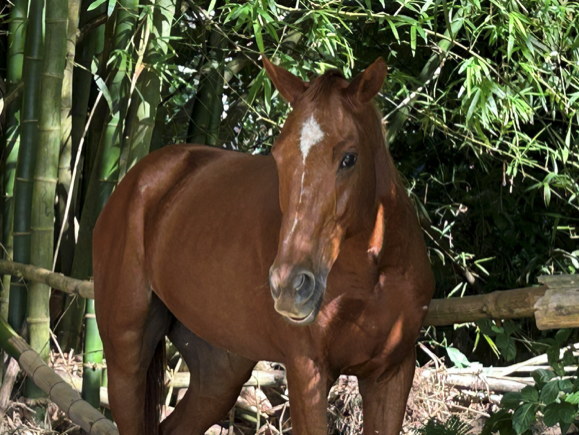
Here at the farm, we are blessed with the presence of Don Carlos R. He was retired to CTA in March of 2020 after becoming the most famous racehorse in Puerto Rico. He won the Copa Confraternidad at La Rinconada in Caracas, Venezuela, the biggest win of his career. Today he spends his days with his herd-mates Tito Discount and Baby Lago under the bamboo trees next to the river on our farm. He’s found a second calling as the star of our Sanarte Equine Assisted Learning program healing people now that he is healed himself.
If people want to help your program, what can they do?
There are several ways people can help:
- donating directly (right now our priority need is fencing and land preparation for our new 50-acre sanctuary)
- sponsoring a horse
- adopting or fostering a horse who’s ready for a new home
- volunteering at the farm
- following and sharing our work on social media so we can reach more people.
We’re also always glad to talk with donors interested in funding a specific need, like our next container load of hay.
Be sure to check out their website and follow their social media accounts.
To learn about another terrific aftercare ally, click here to learn about Central Kentucky Riding for Hope.